
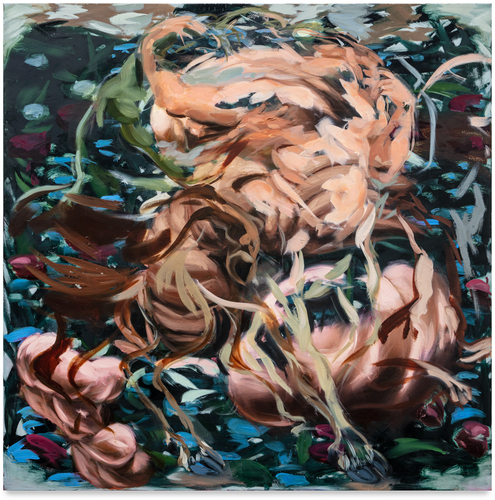
Eleanor Johnson, She Turned His Hands to Feet (2025). Courtesy of the artist and Harper’s.
Artists have always recycled their era’s “Old Masters”: Romans quoted the Greeks, Rodin studied Michelangelo, and Picasso returned to Rembrandt, to name just a few. While the prevalence of these relationships has ebbed and flowed over time, it is peaking again this winter. A striking number of gallery, foundation, and museum shows in New York are foregrounding emerging and established contemporary artists’ interplay with European art history, from Donatello to Goya, with press materials that underscore this lineage almost as strongly as the work itself.
It’s tempting to write off these examples as just more “reference-baiting,” a form of art historical name-dropping meant to lend gravity and market confidence to lesser-known artists. But conversations with the gallerists, foundation executives, and artists behind this season’s shows reveal that several of the citations are much more than a veneer.
Painting Like Their Predecessors
To walk the aisles of an art supply store is to be greeted by fragments of art history, from Canaletto paper and Isabey brushes to Van Gogh and Holbein paint. Two artists with current shows—Émile Brunet and Eleanor Johnson—update this material inheritance for the present.
Brunet’s exhibition at Plato (through March 6) features Northern Renaissance-inspired paintings of neo-rural characters inspired by villagers in Stanstead, a U.S.-Canada border town in Quebec where he currently resides. The resulting works filter the austerity of Hans Memling and Holbein through a contemporary lens, rethinking the history of farm work and the accompanying urban fetishization of pastoral life.
Brunet previously worked for a small arts-material manufacturer (Kama Pigments) and uses its paint exclusively. He explained the choice by citing “a deep interest in alchemy, chemistry, and traditional materials.” For Brunet, the medium is the message.
“As my relationship with materials deepened, the visual language of the Northern Renaissance began to feel increasingly familiar and intuitive to me,” he said, stressing the interdependence between the era’s technical and material innovations, as well as its “broader intellectual framework—one shaped by Erasmian Humanism and early empiricism.” The resulting fictional portraits rebuild the present through the past and enable him to explore at an atomic level “how medieval and Renaissance imagery can remain relevant beyond the realm of fantasy or pastiche.”
Just as material becomes Brunet’s access point to Netherlandish art, Johnson—featured in a two-person show at Harper’s, through February 14—turns to brushwork and processes from a different Flemish moment. She embraces Rubens’s style to produce canvases that read like dreamy, scrambled recollections of the Antwerp artist’s masterpieces.
“The Baroque, with its excess, feels particularly resonant today—many of us are living through busy, fast-paced, information-overloaded lives, and that sense of intensity and saturation feels similar to me,” she said.
“Intensity” and “saturation” are key words in Johnson’s practice. “[Rubens] had an ability to capture the translucency and complexity of skin… through glazing and color theory,” she explained, pointing to his use of “washes of red over green” to create “a pearlescent quality in flesh.” Johnson not only borrows Rubens’s palette but also his working method: alla prima (wet-on-wet) passages, along with his embrace of pentimenti as evidence of thinking on the canvas. Like the canonical Antwerp artist, her compositions are built by layering numerous coats of paint (sometimes as many as 10), a cycle she described as “adding and taking away…revealing and concealing.”
The resulting paintings are packed with frenzied, swelling figures that visually recall Rubens’s exuberant mythological scenes. But the reference is less a direct quote than what she described as “something that surfaces through the process, as part of what might make a painting feel subtly Rubensian.”
Art History in the Age of the Endless Scroll
Another force driving this transhistorical escalation is technological unease. As early as the 1950s, Marshall McLuhan warned that the electronic age would usher in an “age of anxiety,” as easy access to mass media would dull the senses, hamper critical thinking, and produce a kind of collective numbness—one that, in his view, only artists could counter. The winter of 2026 is proving him right inside and outside New York’s galleries.
“We are bombarded in daily life by a sea of disposable imagery,” Harper Levine, owner of Harper’s gallery, told me. “Contemporary artists who anchor work with historical antecedents are mining the viewer’s yearning for recognizable aesthetics in a tumultuous world.”
Asked about the motives behind this surge in practices and shows deeply engaged with art history, Plato founder Elena Platonova similarly identified “the meteoric technological advances and A.I.’s ability to imitate humans,” as well as “access to an unprecedented amount of data about the past.”
“There is comfort in relating to the cultures that have risen and fallen over the centuries, only to be outlasted and immortalized by their art,” she added.
This pressure is pushing certain artists to create works that wade into the relevance of foundational concepts like meaning and originality in the endless sea of information. Kurt Kauper, who is showing at Ortuzarthrough February 28, is presenting paintings shaped by a deliberately broad set of sources. After I reached out for comment, the gallery also sent a reference PDF that expressly paired his paintings with works by Édouard Manet, Jean-Antoine Watteau, Giorgione, Sassetta, Morandi, and more—a bombardment of classic and contemporary images not dissimilar to my own Instagram Feed.
“I’ve always been inspired by traditional Western painting, but I started overtly ‘taking’ from those paintings because I wanted a way to generate an image without concerning myself with meaning as the main driver of the image,” Kauper explained.
Rather than absorb or litigate the historical weight of classical artists, he wanted to “start with pose, attitude, or composition, and then modify them to create a new, indeterminate, emotive experience”—an approach he has been exploring since 2019. The sheer breadth of his quotations weakens the authority of any single citation, reducing these titanic art historical pillars into manageable formal problems. In turn, his paintings test what it means to make connections across time when time itself has begun to collapse beneath the sheer weight of information.
“Cross-Pollinating” Conversations
The signals are mixed on whether this wave of transhistorical dialogue has meaningfully transformed cross-category collecting or its audiences. Artnet’s reporting on the 2025 edition of Frieze Masters, for instance, noted renewed momentum for historical work amid the cooling of the ultra-contemporary market and the arrival of younger buyers eager to purchase works across multiple time periods or cultures.
“I’ve definitely recognized collector interest in non-contemporary work,” says Levine. Works that reference art history, he adds, “expand the collector base because they’re more digestible to a wider audience.” From there, he sees a feedback loop: “This desire to discover historical artists who are unknown, forgotten, or little appreciated, then spreads to current artists who have adopted art historical techniques or sensibilities.”
Pricing is part of the story, too. “I think many assume that Old Masters will be way pricier than contemporary [art] and are surprised they can participate in both,” said Kathy Grayson, the owner of The Hole, whose program includes multiple artists with strong connections to art history. Grayson mentions a recent episode in which a collector paired a work from the 1700s with a painting by Matthew Stone (whose latest gallery show featured Caravaggesque figures painted using custom-built machines at MATR Labs in Red Hook).
Still, she’s not convinced this one instance signals a sustained trend: “I don’t think anyone I’ve sold an Alex Gardner to also has a Parmigianino, and no Andy Dixon buyer has a Willem Heda—at least I don’t think so!” Instead, she sees these crossovers as part of a broader diversification of collecting that now extends into categories like Memphis design, collectibles, and fossils.
That same diversification is mirrored in the public’s appetite for transhistorical presentations. Beyond contemporary interventions at the Frick Mansion and Frick Madison, and in The Met’s Byzantine galleries, foundations from the Flag to the Hill have leaned into cross-temporal hangs.
“We can bring in audiences who may typically seek out only Old Masters or contemporary art, for instance—and we can cross-pollinate those interests,” says Sarah Needham, the director of the Hill Art Foundation, which is currently showing photographs by Robert Bregman paired with select Old Master paintings from the collection. For Needham, building dialogues across time invites “conversations that are not only formal, but metaphysical,” prompting the question: “What are the ties that bind us as humans, across centuries?”
Ultimately, Platonova puts it most plainly: “Artists are the ones who are tuned in to the currents of time; we just need to pay attention to what they make"—J. Cabelle Ahn